Neo Traditional Tattoo Guide: History, Evolution, and Why It’s So Popular Today
Walk into any modern tattoo studio, and you will likely see vibrant, illustrative pieces that seem to leap off the skin. These works feature rich color palettes, deep dimensions, and intricate details, yet they still retain the heavy, unmistakable outlines of old-school body art.
This style is neo-traditional, a genre dominating the contemporary tattoo world and showing absolutely no signs of slowing down.
Born from the bold foundations of American traditional tattooing, neo-traditional tattoo has grown into something truly its own. Whether you are a first-time collector or a seasoned enthusiast, this guide covers everything you need to know, from its roots and evolution to the most compelling design ideas available today.
What Is a Neo Traditional Tattoo?
The neo-traditional tattoo represents a sophisticated evolution of old-school American body art. This movement preserves the thick, protective black borders that prevent ink from blurring over time, but enhances the artistry within those lines.
Instead of relying on flat, primary colors, modern practitioners use complex color gradients, illustrative realism, and deep dimension. Common examples include stylized lady faces, ornate pocket watches, mythological creatures, or floral patterns. These unique designs use heavy saturation and multi-tonal shading to create immense visual depth.
History and Evolution of Neo Traditional Tattoos
To understand the history and evolution of neo-traditional tattoo designs, we have to look at the traditional American tattooing style that emerged in the 1800s. It grew popular for its straightforward visual language, bold imagery, strong lines, and a limited color palette that worked reliably on skin.
Artists like Norman Collins, known as Sailor Jerry, and Amund Dietzel became defining figures of this era. They built their work around thick black outlines, a restrained palette of red, green, yellow, and black, and iconic motifs such as anchors, eagles, and roses.
As technology advanced through the late 1980s and 1990s, artists began pushing against these boundaries. Japanese tattooing traditions, particularly Irezumi and Horimono, introduced flowing compositions and provided the DNA for large-scale dramatic storytelling.
Art Nouveau and Art Deco movements added ornamental elegance and decorative linework. Thus, neo-traditional body art was born, and it kept evolving across each decade until it became one of the most sought-after tattoo styles in the world today.
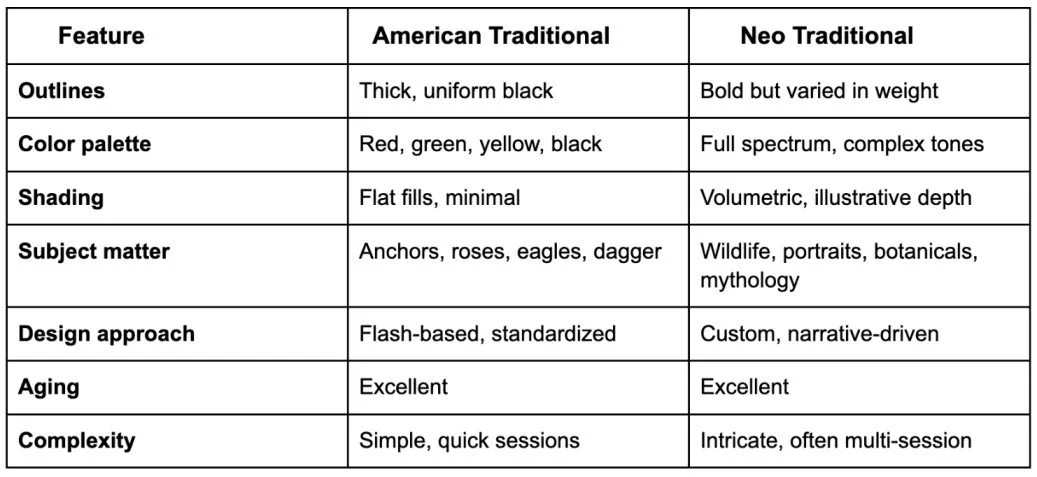
Neo-traditional Tattoo vs Traditional American
Traditional American and neo-traditional tattoos are often mentioned in the same breath, and understandably so. However, there are some clear differences worth understanding before you book your next piece.
Let us take a closer look at these two styles:
Why Neo Traditional Tattoos Are So Popular in 2026
The explosive rise of neo-traditional tattooing is no accident. It thrives because it offers the best of both worlds: the longevity of an old-school piece and the artistic freedom of a modern custom illustration. Here is why it continues to dominate in 2026.
1. They Connect Boldness With Artistry
Neo-traditional sits at a unique crossroads. It connects the timeless confidence of classic tattooing with the creative depth of fine illustration. People who love bold, graphic designs but want more artistic complexity find exactly what they are looking for here. And those who appreciate detailed work but are not drawn to hyperrealism find a comfortable, expressive middle ground.
2. Built to Last
There is a well-known saying in the tattoo world: “Bold will hold”. It means that thick black outlines and solid color contrasts age better and last significantly longer than delicate work. Fine-line tattoos, while beautiful when fresh, can blur into an indistinguishable shape over time as the skin changes. Neo-traditional’s bold structural outlines look just as sharp and clear a decade later as they did on day one.
3. Unlimited Subject Range
Almost any subject translates beautifully into neo-traditional. Animals, mythology, portraiture, botanicals, and fantasy are just a few muses that translate beautifully into the style. The remarkable thing is that neo-traditional accommodates all of them without ever losing its visual identity. This gives collectors an essentially limitless creative canvas and makes it easy to build full sleeves or body suits over the years without ever hitting a creative ceiling.
4. Social Media Photogenic
In an era where a single post can send an artist's waitlist from months to years, the visual impact matters enormously. Neo-traditional body art is heavily driven by younger audiences, particularly Gen Z, who document their tattoos the moment the wrap comes off. These pieces are instantly eye-catching on Instagram and TikTok and highly shareable the moment they are posted.
5. Artists Can Add More Detail Without Losing Readability
One problem with detailed tattoos is that too much complexity can make the design look crowded. Neo traditional tattoos solve this by combining detail with strong composition. The artist can add texture, ornamentation, shading, and decorative elements while keeping the main shape clear.
This is especially useful for animals, portraits, flowers, and fantasy-inspired designs. The tattoo can feel rich and artistic without turning into visual noise. That balance between detail and readability is one of the biggest strengths of the style.
Iconic Neo Traditional Tattoo Ideas and Motifs
Neo-traditional tattooing does not follow the “less is more” philosophy. It is a full celebration of artistry, color, and storytelling, made for those who want their ink to say something meaningful and look extraordinary doing it.
While there are countless directions you can take this style, here are some of the most iconic and timeless neo-traditional tattoo ideas to spark your inspiration.
Source: SOH Tattoo
1. Neo Traditional Tattoo Black and Grey
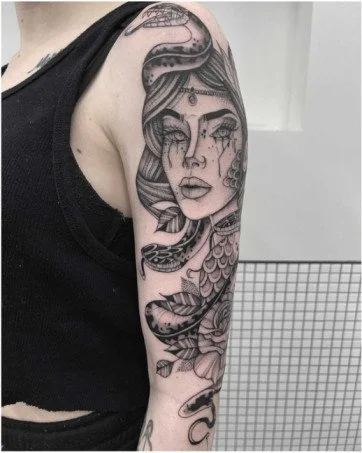
Neo-traditional tattoos are widely known for their bold, saturated colors, but strip that away, and something equally powerful emerges. Black and grey neo-traditional work shifts the focus entirely onto mood, depth, and technical finesse. The shading does the heavy lifting to create a rich and dramatic atmosphere that color sometimes overshadows.
This approach tends to suit collectors who want to feel a deeper, more somber connection to their subject matter without being flashy or overdone. A strong example is a black and grey portrait of a woman intertwined with a coiled snake, rendered with fine detail and expressive linework.
Placement Idea: The upper arm and shoulder sleeve are ideal placements for this kind of tattoo.
Source: Pinterest
2. Ornate Floral Arrangements
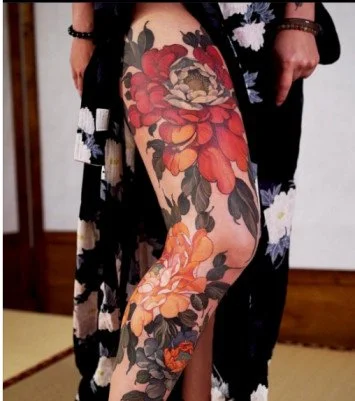
Floral tattoos remain one of the most timeless choices in tattooing, and neo-traditional brings them to life in a truly remarkable way. Whether executed in vibrant full color or muted, earthy tones, flowers carry layered symbolism that resonates across cultures and generations. Peonies represent prosperity, good fortune, and romance, while roses speak to love, beauty, and the delicate balance between pleasure and pain.
A flowing composition featuring large blooming peonies in warm reds, burnt oranges, and deep golds, surrounded by dark botanical foliage, makes for a breathtaking statement piece.
Placement Idea: The thigh and upper leg are the most natural placements for this kind of floral work.
Source: Pinterest
3. Neo Traditional Panther Tattoo
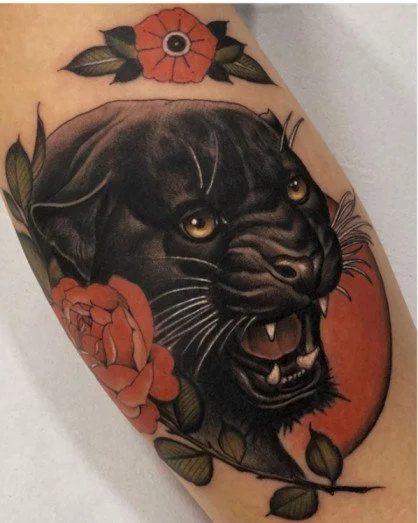
Powerful, mysterious, and fiercely protective, the panther is one of the most enduring emblems in tattoo culture. It represents strength, courage, and a quiet but undeniable confidence.
In the neo-traditional style, the panther becomes a truly striking subject. The deep black fur contrasts beautifully against warm red tones and bold circular framing. To soften the overall intensity without diminishing it, artists often accompany the predator with roses and delicate floral accents.
Placement Idea: The forearm and calf are both strong placement choices for this design.
Source: Pinterest
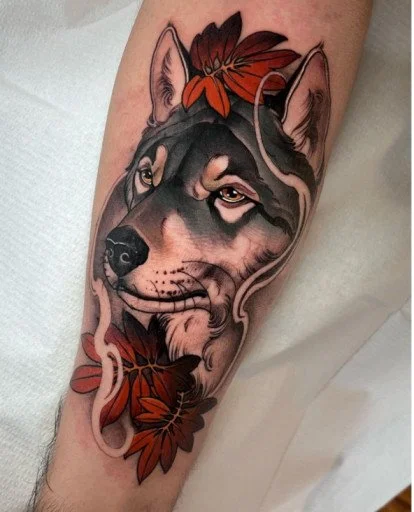
4. The Illustrative Wolf
Across global cultures and folklore, the wolf is considered a profound symbol of loyalty, family, and deep intuition alongside freedom and courage. In neo-traditional style, the wolf becomes an expressive, character-driven portrait rather than a flat decorative symbol. A forward-facing wolf tattoo surrounded by rich autumn botanical elements makes for a deeply personal and visually compelling piece.
Placement Idea: Place it on the forearm.
Source: Tattoo Life
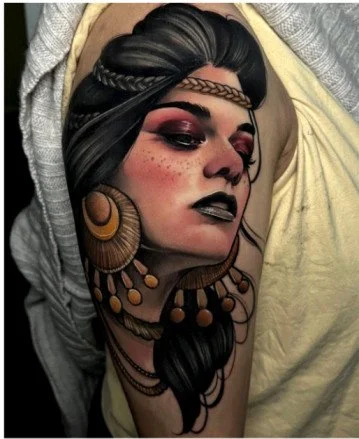
5. Stylized Portraiture and Lady Heads
Portrait and lady head tattoos hold a long and deeply respected place in neo-traditional body art. Historically, the female face has represented beauty, mystery, intuition, and the divine feminine. In the neo-traditional style, these qualities are amplified through rich illustrative detail.
These portraits move well beyond simple likeness, becoming fully realized characters adorned with ornate jewellery, bold makeup, flowing hair, and decorative accessories. Think of a portrait of a dark-haired woman wearing layered gold jewellery and a braided headpiece. Soft but distinct shading combined with warm skin tones showcases the true potential of this style.
Placement Idea: Place it on the upper arm or shoulder
Source: Pinterest
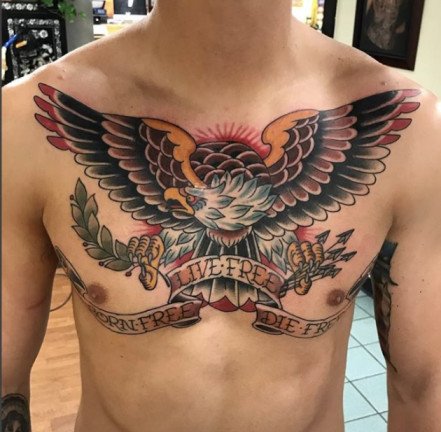
6. The Sovereign Eagle
The eagle has always represented sovereignty, vision, and absolute freedom; it is also one of the most requested motifs in neo-traditional tattooing. In neo-traditional style, the eagle transcends its traditional roots and becomes a genuinely commanding composition.
A spread-winged eagle tattoo clutching olive branches and arrows creates a timeless statement of power. Bold banner script frames the majestic bird and anchors the entire design. Deep blacks, warm golds, and rich reds elevate the composition while delivering a striking visual impact.
Placement Idea: Below the collarbone on the chest.
Source: Reddit
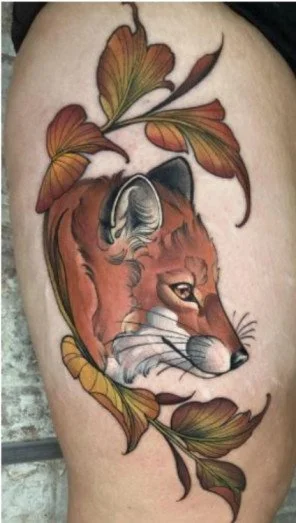
7. Neo Traditional Fox
Foxes are typically associated with cleverness, adaptability, and quiet wisdom across both Western folklore and Eastern mythology. As body art, the fox is rendered with warmth and character, becoming less of a symbol and more of a personality. The portrait-style fox head surrounded by autumn ginkgo leaves, executed in rich burnt oranges, earthy reds, and golden tones, beautifully captures the spirit of the subject.
Placement Idea: The thigh is a well-suited placement for this kind of composition.
Source: Tattoo Artists
8. Mythological Beast Tattoo
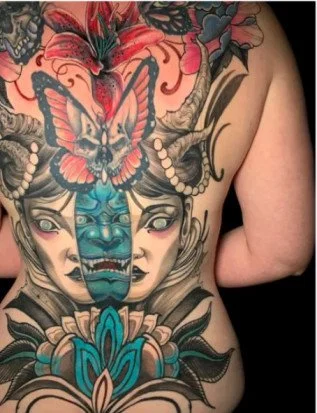
Neo-traditional tattooing has always had a natural affinity with mythology and the supernatural, and few subjects showcase the style's range better. You can choose a full back composition featuring a dual-faced figure, split between a human visage and a supernatural creature. It is one of the most dramatic directions neo-traditional tattooing can take.
This kind of design draws heavily from Japanese Oni mythology, where demons and humans exist not as opposites but as two sides of the same nature.
Placement Idea: The back is the only placement that truly does justice to such compositions.
Source: Pinterest
9. Geometric Mandala
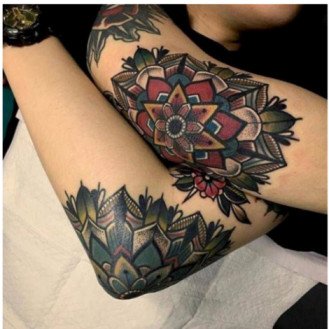
The roots of the mandala can be traced back to Hindu and Buddhist spiritual traditions, where it represents the universe, wholeness, and the journey inward toward self-understanding. You can reimagine it with bold outlines, rich jewel-toned fills, and decorative botanical detailing that gives it real visual weight.
A layered mandala featuring deep teals, burgundy reds, and forest greens creates a striking centerpiece that commands attention. Intricate geometric patterns merged with modern depth can transform an ancient spiritual symbol into a mesmerizing statement piece.
Placement Idea: Place it around the elbow or knee to align with the body’s contours.
Source: Tattoo Life
10. Neo Traditional Surrealism
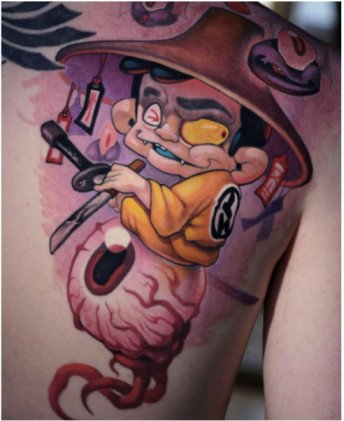
One of the most creatively expansive directions within neo-traditional tattooing is surrealism. Here, the rules of reality are set aside entirely in favor of vivid, imaginative storytelling. This approach combines exaggerated characters, unexpected imagery, and bold colors to create pieces that feel like scenes lifted from an illustrated graphic novel.
Imagine a mischievous folkloric figure wearing an oversized hat and wielding symbolic objects, taking center stage in this design. A swirling, atmospheric background frames the character, adding a sense of mystery and depth. This storytelling approach showcases the exact kind of composition that thrives in the genre.
Placement Idea: The back or shoulder offers the most generous canvas for surrealist designs.
FAQs
1. Where did neo traditional tattoos come from?
Neo traditional tattooing grew from American traditional tattoo foundations, then expanded with influences from Art Nouveau, Art Deco, Japanese art, and modern illustration. These influences helped shape the style’s decorative frames, flowing shapes, elegant details, and dramatic color palettes.
2. What is the difference between traditional and neo traditional tattoos?
Traditional tattoos usually use bold lines, simple shapes, limited colors, and flat shading. Neo traditional tattoos keep the bold structure but add more dimension, varied line weight, blended color, ornate details, and a more artistic finish.
3. What designs work best for neo traditional tattoos?
Animals, flowers, skulls, daggers, moths, snakes, birds, women’s faces, sacred hearts, insects, and mythical creatures work especially well. These subjects give the artist room to use bold shapes, ornamental details, dramatic eyes, and layered color.
4. Can neo traditional tattoos be small?
Yes, but they should not be too small. If the design includes eyes, fur, petals, jewelry, patterns, or layered shading, shrinking it too much can make the details blur together after healing.
5. Are neo traditional tattoos safe?
They are generally safe when done by a licensed professional using sterile equipment and proper hygiene. Tattoo risks still include infection, allergic reactions, contaminated ink, scarring, and delayed skin reactions, especially if aftercare is poor.
Ready to Wear Art That Lasts a Lifetime?
Neo-traditional tattoos are a genuine celebration of artistry, history, and personal expression. But that same depth and intentionality also make getting one a serious decision. These tattoos are renowned for their lasting visual impact, rich detail, and symbolic meaning, so before committing, take the time to research styles, study artists, and define what you want your piece to say.
Have a consultation with your chosen artist to discuss your ideas and design options. Together, you can create something that truly reflects who you are. The first step toward that piece is finding a skilled artisan who understands both the tradition and the craft.
At Aureo Roma, we offer an exclusive space for serious tattoo lovers, from photorealistic portraiture to micro detail work and everything in between. Visit our website for any queries, and our team will get back to you within ten minutes, or simply walk in for an appointment in the heart of Rome.
Are you ready to get a work of art on your skin?
The AUREO Team can make any tattoo request a reality!
BOOK AN APPOINTMENT WITH ONE OF OUR ARTISTS